Tuesday, July 10, 2007

Social Media Design Concepts


Here from David Armanos blog are some great diagrams depicting how to design impactful blog-websites You can watch the whole show, but Slides 40 to 45 are the most important for those interested in social media design.


Monday, July 02, 2007

The Creative Tension of CPA

In February I posted this in response to the increasing notice of Linda Stone's meme "Continuous Partial Attention".

Thoughts Illustrated: Who is Linda Stone and why should we listen to her?

Today I will meet with Stowe Boyd who argues with Stone that the Social Presence tools like Twitter and Pownce, and to some degree, Facebook, offer a "flow" experience that we need to accept as a "gift" from our AORTA technologies.

Perhaps Stowe can enlighten me on how he manages his "flow"

Although this is from an article in InfoWeek last February it restates the key issue in designing tools for collaboration for enterprise.

"For the Enterprise 2.0 strategy to work, it's essential that Web collaboration tools be used to streamline communications. If they just add another channel, they'll only make the communication and collaboration problem worse."
Business Tech Pros Wary About Web 2.0 Tools In Business -- InformationWeek Daily --
InformationWeek:

As we consider integrating a social presence tool in our collaboration suite, we need a way to "manage" the multiple channels competing for our attention. I think the solution will be to provide meta-level visualization of the flow so we can comprehend its meaning. David Brin's Holocene vision?


Saturday, June 23, 2007

Congratulations to my son Scott - in the current issue of Wired


Not just because Scott, who is pictured above, is my son and the President of Raydiance, the story is a great multimedia read about the innovative technology of ultrashort pulse lasers and the software platform that Scott and Barry Schuler, Chairman of Raydiance are building.

Barry likens the opening of the Raydiance development platform to the way Microsoft Windows platform developers helped build Microsoft's huge ecosystem and a world dominant information industry leader.

Knowing both Barry and Scott, I have a firm belief that they are creating something truly revolutionary - at the intersection of software and nanotechnology. Raydiance may just be the Next Big Thing!

Although Raydiance was previously featured in a recent Business Week article, this WIRED piece shows how pictures help to tell the story more powerfully. The writer, Danny Dumas provides an expert insight into company and its technology and WIRED's use of visuals and great web design makes this one of my all-time favorite TI stories.

It also helps when you can tell family and friends people what your son does at work.

The Ultrashort Pulse Laser in Action

Trust Metrics for Social Networks

Sam Rose on the Facebook for Business group suggested that trust metrics would be needed to assure that FB social networks in business could be measured providing management or social network members themselves a way to visualize the "strength" of Trust, Reputation and Security in making decisions about how to apply the key principles of Wikinomics in business settings.


In my several eLearning presentations on Wikinomics I used the diagram above to present the key themes of the book and to use it as a template(map) for audience interaction. Audience reactions to the map elicited comments from several in the audience such as the one from the Director of Worldwide Education for Genentech in which he said that at least for his firm issues of legal liability, risk of sharing trade secrets or other IP required a mechanism to control the amount of Open, Peering and Sharing and how broadly Global such a process could be.

This led me to consider the red circle in the diagram as a feedback system in which the visual of the circle would expand or contract( thus add or subtract value from collaboration) through the key elements of successful collaborations shown on the diagram.


For many years I used the Bell-Mason spider diagram ( example below) to visualize the vital signs of startup businesses, and developed an ontology of key elements of business to "populate" the diagram. What this does is to provide a Vital Signs chart similar to the way medical diagnostics pictures key health metrics. This charting approach offers a neat way to map from qualitative, subjective judgments to a quantitative metric that drives the spider on the chart. It can be used for snapshot assessments, or in time series to show trends.


I used these charts as a dashboard approach to venture portfolio project management as a VC and later as an Angel investor, and keeping in mind Korzybbski's dictum "the map is not the territory" I found metrics at this level of abstraction to be very helpful in gettting a quick diagnostic about startup progress, and to make investment or intervention decisions.

Price Waterhouse adopted Bell-Mason diagrams for a number of years to portray "paths to value" in the venture capital arena and I think they can be applied to measuring the vital signs of collaborative ecologies.

The key point here is ranking subjective, qualitative information into numbers-driven quantitative displays for decision-making. I plan to "crowdsource" the development of a vital signs diagnostic for social networks in business with Sam Rose and others in the Business group, and to encourage them to investigate the use of Wikinomics principles in their work.

The Art of the Start -


This beautiful drawing by David Armano should be mashed up with Guy Kawasaki's The Art of the Start handbook for startups. Although David drew it to illustrate his design agencies ecosystem, it also pictures the system elements of new product and early stage company development.

A Thoughts Illustrated favorite!

Logic Emotion: Agency Ecosystems

Friday, June 22, 2007

Facebook Gets Help From Its Friends - WSJ.com


Thanks to my Facebook friend Rodney Rumford and his post on FaceReviews FaceReviews.com :: Facebook Application Reviews, Facebook Widgets and Facebook News. Sharing the Facebook Blog love.

Facebook Gets Help From Its Friends - WSJ.com: "Facebook is actually borrowing a tactic pioneered by Microsoft: Rather than building every piece of technology yourself, let others build on your 'platform,' much the way Adobe Systems Inc., Intuit Inc. and others built software for Microsoft's Windows operating system in the 1980s. Using this strategy, Facebook can nurture an ecosystem of developers who can create services far faster than Facebook could build them on its own."

The Facebook ecosystem now has over 50,000 application developers working to increase the user value of the Facebook platform - a number that is growing by almost 10% per day - and Rodney's Facebookreviews is providing a needed service by scanning this huge source of new applications to locate the "good stuff" for you.

If he can keep up with the rapid growth of Facebook applications to recommend the ones you can use to power your social networks , he will be in the catbird seat - with a 50,000 foot view of this amazing ecosystem, and a significant player in building brand value for Facebook and the applications it selects to review from the burgeoning developer network.

IMHO the launch of the Facebook Platform will be a watershed event in the history of the Web as it grows to become THE social network "for the rest of us". All that's needed to accelerate Facebook into sustainable orbit velocity is to become the user's choice on their mobile devices. Think Facebook on iPhones - social networking on steroids!

Wednesday, June 20, 2007

Kim Polese and Spike Source - another Wikinomics story


In preparing for a presentation on Wikinomics I wanted to feature SpikeSource and its "rockstar" CEO Kim Polese as a sterling example of Wikinomics principles in action. Kim has been featuring podcasts with Don Tapscott and Wikinomics in her marketing website,sort of closing the loop.

These BW slide shows are really great shortcuts to learning about featured topics and the format for presentation on the web site is the best I have seen.

Thanks to google images, and Business Week I have the content I need for my presentation - which, incidentally will be available for free download from the eLearningForum, my sponsor for my gig this Friday.

The New Wave in Open Source | BusinessWeek

Tuesday, June 19, 2007

Ning to Facebook in one click.


Ning is a social networking site started by Mark Andreeson of Netscape fame whose comments on Facebook were in my previous post Thoughts Illustrated: The importance of the Facebook Platform Explained

After realizing the importance of Facebook as a platform it only took Mark 5 days to enable Ning's 65,000 ( his claim) social networking sites to port over to Facebook with one click.

blog.pmarca.com: How to effortlessly inject your content into Facebook, using Ning

Who Needs College? The Triumph of Young Web Founders


Who Needs College? The Triumph of Young Web Founders

Monday, June 18, 2007

Who Participates And What People are Doing Online


A nice chart of data from Forrester Research . This is just a small clip from a larger comprehensive chart which accompanies the full story.

read more | digg story

Mass Collaboration Designs and Builds for Boeing


SuiteTwo - Spikenet integration

Click on the podcast of Kim Polese interview with Don Tapscott relating another Wikinomics story of mass collaboration.

Friday, June 15, 2007

The importance of the Facebook Platform Explained


Two great articles on the importance of the Facebook Platform

Here from David SacksThe New Portals: It’s the Bread, Not the Peanut Butter

Courtesy of Mark Andreeson blog.pmarca.com: Analyzing the Facebook Platform, three weeks in

from a Facebook msg from Robert Scoble.Facebook | Message: facebook addiction

Notemark - Clip, save, share from your browser


A new tool for clipping from the web - also a WebEx partner. I think I can use this app, and also see it as a utility for ConversationBase.

The Amazing Recursiveness of the Web!

In continuing preparation for my presentation on Wikinomics, and as a result of a conversation with Chris Carfi of Cerado, I learned about Spikesource and CEO Kim Polese's interview with Wikinomics author Don Tapscott.

In addition to recognizing Spiksoure as a wikinomics story, the AntTrail from linking to the Spikesource story led me to this Webinar invitation to Kim's interview- powered by, surprise!, WebEx, who will also be providing the remote broadcast service for my presentation on June 22.

The feeback loop here is recognizing also that Spikesource is a potential platform partner for ConversationBase, and for delivery of Networked Books into the corporate market. First book up is, obviously, Wikinomics!

SpikeSource - SuiteTwo

Presentation Research -Discovery through Google Images


In preparing for my second presentation for the eLearning Forum on the subject of Wikinomics I wanted to use the power of time-shifting and stored "memory" exemplified by TiVo.

My "ant-trail" 1. Search google images 2. select the image shown above 3. Follow the image link to find this 4 year-old post Church of the Customer Blog

"Student volunteers, who received free pizzas for their labor, helped with the assembly of the system, essentially an array of large refrigerators to keep the computers from overheating. Virginia Tech's president offered free football tickets to the technicians who were spending long hours on the project.

"'When you have a small budget," said Srinidhi Varadarajan, a leader of the project, "you have to take risks.'"


Voila! a perfect example of the principles of Wikinomics in action and another story for the Wikinomics playbook.

Time-shifted and stored in the "memory" of the Church of the Customer blog and discovered through google image search. Their tag cloud on the blog piques my attention. Maybe we should introduce them to ConversationBase .

Wednesday, June 13, 2007

Food for the right side of your brain


Take 2:43 minutes to savor this art history video with a mashup/remix of a Bach cello soundtrack by YoYoMa and some of the most enchanting female faces you will ever see.

This short video is an example of the 1% of YouTube that is worth watching.

Thanks to my daughter Susan Barb for the link.

Kawasaki Redux - another side of the Truemor story


From Toronto Globe and Mail technology writer Matthew Ingram: Kawasaki: How I wasted $12,107 on Truemors � mathewingram.com/work

I agree with Michael about how inconsequential Truemors appears to be, but I think Guy's new contrarian mantra is worth considering.

"No Plan, No Capital,No Model....No Problem"

The opportunity to create a viral microenterprise has never before been so attractive For example,on the heels of the public launch of the Facebook Platform, accompanied by such heavy weight application development partners as Amazon and Microsoft, over 42,000 wannabe's have signed on as application developers- a list that is growing bhy over 10% PER DAY!

Like Truemors they may find it possible to launch an application on the cheap and expect the viral distribution channel of Facebook to give them orbital velocity, and, using Guy's Truemors numbers - the expecations that anyone of these could gain initial success and market visibility for $12,107 is going to fuel a land grab.

But let's say that only 1% of these startups succeed - the cost of supporting all the losers amounts to $484,500,000 -- not a great ROI.

I think this exploding cadre of application developers on Facebook and now on the new iPhone Platform will generate some real winners - but sorting through 40,000 business models at the startup level is not the job of professional investors so, family, friends and angels will pony up the early funding for these nascent products and companies and generally lose their shirts.

Guy Kawasaki - the contrarian VC

Here is a great little presentation supporting Guy's new mantra -
" No Plan, No Capital, No Model…No Problem: Companies that Defied What VCs Will Tell You"

Tuesday, June 12, 2007

Be Like the Internet - from GetSatisfaction.com

Here is a beautifully done slide presentation from slideshare.

Monday, June 11, 2007

running the numbers - an american self-portrait and a visual surprise!


current work

"This new series looks at contemporary American culture through the austere lens of statistics. Each image portrays a specific quantity of something: fifteen million sheets of office paper (five minutes of paper use); 106,000 aluminum cans (thirty seconds of can consumption) and so on. My hope is that images representing these quantities might have a different effect than the raw numbers alone, such as we find daily in articles and books. Statistics can feel abstract and anesthetizing, making it difficult to connect with and make meaning of 3.6 million SUV sales in one year, for example, or 2.3 million Americans in prison, or 426,000 cell phones retired every day. This project visually examines these vast and bizarre measures of our society, in large intricately detailed prints assembled from thousands of smaller photographs.

My only caveat about this series is that the prints must be seen in person to be experienced the way they are intended. As with any large artwork, their scale carries a vital part of their substance which is lost in these little web images. Hopefully the JPEGs displayed here might be enough to arouse your curiosity to attend an exhibition, or to arrange one if you are in a position to do so. The series is a work in progress, and new images will be posted as they are completed, so please stay tuned."
From the Seattle-based artist Chris Jordan

Chris Jordan has put together a museum quality exhibit to present statistical evidence through surprising and unexpected collages of digital images telling a statistical story in a way that will get you thinking. I am sure the images shown full size in a gallery would be much more impressive, but just scroll down this web-based offering in your browser and you will learn a lot in a hurry.

the CommonCraft Show - simply brilliant!


Lee Lefever produces the most elegantly simple videos called PaperWorks to explain web tools like Wiki and RSS. His style of presentation must be seen to be appreciated. so you can do that right nowhttp://www.commoncraft.com/show

Sunday, June 10, 2007

Network Innovation - a lesson from Apple


Innovation | Lessons from Apple | Economist.com: "This approach, known as “network innovation”, is not limited to electronics. It has also been embraced by companies such as Procter & Gamble, BT and several drugs giants, all of which have realised the power of admitting that not all good ideas start at home. Making network innovation work involves cultivating contacts with start-ups and academic researchers, constantly scouting for new ideas and ensuring that engineers do not fall prey to “not invented here” syndrome, which always values in-house ideas over those from outside."

Network Innovation is well described in Wikinomics - with its core principles Open, P2P,Sharing, Global. - Apple appears to have its cake and eat it, violating the key principle of openness, but gaining innovative advantage through adopting other's innovations( think Xerox Altos) and focusing on sleek, sexy,fashionable design.

iTunes is the newest version of Apple's network innovation. Its almost hidden agenda is its insertion as a virus-like component on the Windows platform where, unexpected, it resides as a remorahttp://en.wikipedia.org/wiki/Remora . iTunes and the soon to be shipped iPhone
are stealth invaders of the Windows platform - where any iTunes enabled device, MAC or PC is "recognized" and connected to share any iTunes content. It is a network innovation of mostly unseen and unexpected scope - imagine an Apple networking widget on every Mac and Windows PC. That's iTunes - and guess where iPhone will connect as a Network Innovation?

Who knew?

Monday, June 04, 2007

Yi-Tan on FaceBook and Widgets


The Gladwellian Connector pictured above is Jerry Michalski, founder of Yi-Tan, a collective which uses the chinese symbol above to mean: Conversations About Change.

Here's how Jerry describes what his collective is all about:

"We're here as part of a larger network to explore, prototype, adopt and recommend solutions around social media and technologies that are going to change the way people communicate, collaborate, engage with each other and organise for work and play."


I met Jerry last year at Meshforum 2006, and today accepted his invitation to listen on his weekly Yi-Tan community conversation - sort of a dial-in radio talk show with Jerry as the host. The subject of today's call was a timely exploration of the meaning of the "new" FaceBook
Platform and how it may effect the solution set that Yi-Tan has been exploring.

If you didn't get the invitation in time to hear the conversation, the link above will take you to the podcast archive of the call. Given time, I will attempt to synthesize the conversation, so you won't have to listen to the full hour to get the gist - but here is my takeaway:
"Facebook is emerging as an important player in the intersection between social networks and how people communicate through conversations".

I have just joined as a member of Facebook as you can see from my sidebar, and intend to learn as much as I can what all the buzz is about.


Tuesday, May 22, 2007

Logic+Emotion - moving the needle on the Experience -O-Meter

David Armano - a graphic designer based in chicago has uploaded this brilliant PPT on slideshare.net Here are a few examples. Click on the images for a larger version where you can more easily read the smaller typefaces. Then scroll down to the embedded presentation to see all of David's Visual Library. Outstanding!


veotag player

veotag player

veotag player

Monday, May 21, 2007

The Members Project by American Express


A superb demonstration of mass collaboration and a great branding statement .

Watch the short welcome video - and if you have an American Express card and a great idea for a project to change the world, join in!

The Members Project

architecting conversations -


Here's the point on slide 39. If you want to get the build-up, scan the whole presentation below.

Saturday, May 12, 2007

visualizing complexity by STAMEN

San Francisco’s Stamen Design is a boutique services firm specializing in data visualization, map making, interactive media, and creative technology reinterpretation. You might remember Stamen from such projects as Mappr, MoveOn.org’s Virtual Town Hall shown above. Click on the link below to see the entire slideshow describing the Moveon project. Take a close look at slides 17-22, where Stamen explains the power of building online presence through visualization. We need to talk with these guys! I have made the call.

MoveOn.org's Virtual Town Hall

Sunday, May 06, 2007

NASA CoLab in San Francisco

Another wikinomics-like project - open-source collaboration software. NASA has opened a co-working physical space for collaborative software development along with a virtual space in Second Life-where NASA's virtual imagery promises to play a big role in advancing SL's relevancy and reach. Great mashup - NASA and SecondLife and RealLife CoLab.

FCW Reports on CosmosCode | NASA CoLab

CoLab invitation:
"NASA invites the open-source community to help it create space exploration software. NASA’s desire for Web 2.0 collaboration software signifies the agency’s new leadership in developing open-source applications in the government."

Friday, May 04, 2007

spash cast - RSS and multimedia -


a look at the splashcast show assembler -- the download is verrrrrry slow.

SplashCast: Channel Yourself Across the Web

Thursday, May 03, 2007

Networks - Forbes.com


Forbes hits one out of the park with this issue on Networks - a treasure trove of commentary and hard facts about the power of Networks like the one by Bob Metcalfe who is the creator of the Network Effect equation shown in the diagram above.

Divided into 4 major sections: Breakthroughs, Lifestyle,Technology and Community, the Forbes issue on Networks is filled with useful information and stimulating ideas.

From the lead:
The 28 essays from a cast of experts and leaders we have assembled from many different walks of life, may help you see networks you hadn't thought about before or make connections you never thought possible. Music, MySpace, massive multiplayer role-playing games--they are all connected here.
Take your time to read it all. If you don't have time to grok it all, I will be posting some snippets here pointing you to my favorites. Stay tuned.

:Networks - Forbes.com

Tuesday, April 17, 2007

The TAO of Topic Maps

The TAO of Topic Maps

Vidoop.com - Security and simplicity at Web2.0 Expo


Single Sign On and Open ID login process Looks interesting Just launched today
Vidoop.com

The ClueTrain Manifesto hits NOAA

slide show on the impact of web 2.0

Monday, April 16, 2007

The Beethoven Page

The Beethoven Page

Pattern recognition - Wikipedia, the free encyclopedia

Pattern recognition - Wikipedia, the free encyclopedia: "The classification or description scheme usually uses one of the following approaches: statistical (or decision theoretic), syntactic (or structural). Statistical pattern recognition is based on statistical characterisations of patterns, assuming that the patterns are generated by a probabilistic system. Structural pattern recognition is based on the structural interrelationships of features. A wide range of algorithms can be applied for pattern recognition, from very simple Bayesian classifiers to much more powerful neural networks.

An intriguing problem in pattern recognition yet to be solved is the relationship between the problem to be solved (data to be classified) and the performance of various pattern recognition algorithms (classifiers).

Holographic associative memory is another type of pattern matching scheme where a target small patterns can be searched from a large set of learned patterns based on cognitive meta-weight."

Rene Descartes - Famous mathematicians pictures, posters, gifts items, note cards, greeting cards, and prints

Rene Descartes - Famous mathematicians pictures, posters, gifts items, note cards, greeting cards, and prints

René Descartes 1596 - 1650


René Descartes viewed the world with a cold analytical logic. He viewed all physical bodies, including the human body, as machines operated by mechanical principles. His philosophy proceeded from the austere logic of "cogito ergo sum" -- I think therefore I am.

In mathematics Descartes chief contribution was in analytical geometry.

Descartes' portrait is quadrisected by the axes of his great advance in analytical geometry: what has come to be known as the Cartesian plane. It enabled an algebraic representation of geometry.

Descartes saw that a point in a plane could be completely determined if its distances (conventionally 'x' and 'y') were given from two fixed lines drawn at right angles in the plane, with the now-familiar convention of interpreting positive and negative values.

Conventionally, such co-ordinates are referred to as "Cartesian co-ordinates".

Descartes asserted that, similarly, a point in 3-dimensional space could be determined by three co-ordinates.

Meme -

Meme - Wikipedia, the free encyclopedia: "he term 'meme' (IPA: /miːm/, rhyming with 'theme'; commonly pronounced in the US as /mɛm/, rhyming with 'gem'), coined/popularized in 1976[1] by the biologist Richard Dawkins, refers to a 'unit of cultural information' which can propagate from one mind to another in a manner analogous to genes (i.e., the units of genetic information).

Dawkins gave as examples of memes: tunes, catch-phrases, beliefs, clothes fashions, ways of making pots, or of building arches. A meme, he said, propagates itself as a unit of cultural evolution and diffusion — analogous in many ways to the behavior of the gene. Often memes propagate as more-or-less integrated cooperative sets or groups, referred to as memeplexes or meme-complexes.

The idea of memes has proved a successful meme in its own right, gaining a degree of penetration into popular culture which relatively few modern scientific theories achieve.

Proponents of memes suggest that memes evolve via natural selection — in a way very similar to Charles Darwin's ideas concerning biological evolution — on the premise that variation, mutation, competition, and 'inheritance' influence their replicative success. For example, while one idea may become extinct, other ideas will survive, spread, and mutate — for better or for worse — through modification."

Richard Dawkins - Wikipedia, the free encyclopedia

Richard Dawkins - Wikipedia, the free encyclopedia: "Dawkins first came to prominence with his 1976 book The Selfish Gene, which popularised the gene-centered view of evolution and introduced the term meme into the lexicon, helping found memetics. "

Richard Dawkins - Wikipedia, the free encyclopedia

Richard Dawkins - Wikipedia, the free encyclopedia: "Dawkins first came to prominence with his 1976 book The Selfish Gene, which popularised the gene-centered view of evolution and introduced the term meme into the lexicon, helping found memetics. "

The Origin of Species - Wikipedia, the free encyclopedia

The Origin of Species - Wikipedia, the free encyclopedia: "Origin of Species (publ. 1859) is a pivotal work in scientific literature and arguably the pivotal work in evolutionary biology.[1] The book's full title is On the Origin of Species by Means of Natural Selection, or the Preservation of Favoured Races in the Struggle for Life. It introduced the theory that populations evolve over the course of generations through a process of natural selection"

Map/territory relation - W

Map/territory relation - Wikipedia, the free encyclopedia: "Korzybski's dictum ('The map is not the territory') is also cited as an underlying principle used in neuro-linguistic programming, where it is used to signify that individual people in fact do not in general have access to absolute knowledge of reality, but in fact only have access to a set of beliefs they have built up over time, about reality. So it is considered important to be aware that people's beliefs about reality and their awareness of things (the 'map') are not reality itself or everything they could be aware of ('the territory'). "

Map/territory relation -

Map/territory relation - Wikipedia, the free encyclopedia: "The map/territory relationship

Gregory Bateson, in 'Form, Substance and Difference,' from Steps to an Ecology of Mind (1972), elucidates the essential impossibility of knowing what the territory is, as any understanding of it is based on some representation:

We say the map is different from the territory. But what is the territory? Operationally, somebody went out with a retina or a measuring stick and made representations which were then put on paper. What is on the paper map is a representation of what was in the retinal representation of the man who made the map; and as you push the question back, what you find is an infinite regress, an infinite series of maps. The territory never gets in at all. […] Always, the process of representation will filter it out so that the mental world is only maps of maps, ad infinitum.

Elsewhere in that same volume, Bateson points out that the usefulness of a map (a representation of reality) is not necessarily a matter of its literal truthfulness, but its having a structure analogous, for the purpose at hand, to the territory. "

Cartography -

Cartography - Wikipedia, the free encyclopedia: "Cartography or mapmaking (in Greek chartis = map and graphein = write) is the study and practice of making maps or globes. Maps have traditionally been made using pen and paper, but the advent and spread of computers have revolutionized cartography. Most commercial-quality maps are now made with map-making software that falls into one of three main types; CAD, GIS, and specialized map illustration software.

Maps function as visualization tools for spatial data. Spatial data is acquired from measurement and can be stored in a database, from which it can be extracted for a variety of purposes. Current trends in this field are moving away from analog methods of mapmaking and toward the creation of increasingly dynamic, interactive maps that can be manipulated digitally.

The cartographic process rests on the premise that the world is measurable and that we can make reliable representations or models of that reality. Mapmaking involves advanced skills and attitudes, particularly the use of symbols to represent certain geographic phenomena, as well as the ability to visualize the world in an abstract and scaled-down form."

Map - Wikipedia, the free encyclopedia

Map - Wikipedia, the free encyclopedia: "map-making is cartography; see that page for further discussion of the history of maps and map-making.

Map-making dates back to the Stone Age and appears to predate written language by several millennia. One of the oldest surviving maps is painted on a wall of the Catal Huyuk settlement in south-central Anatolia (now Turkey); it dates from about 6200 BC. [1] One who makes maps professionally or privately is called a cartographer."

Geographic coordinate system - Wikipedia, the free encyclopedia

Geographic coordinate system - Wikipedia, the free encyclopedia

geocoding explained

Geocoding - Wikipedia, the free encyclopedia

Geocoding - Wikipedia, the free encyclopedia: "Geocoding is the process of assigning geographic identifiers (e.g., codes or geographic coordinates expressed as latitude-longitude) to map features and other data records, such as street addresses. You can also geocode media, for example where a picture was taken, IP Addresses, and anything that has a geographic component. With geographic coordinates, the features can then be mapped and entered into Geographic Information Systems.

A geocoder"

Geocode - Wikipedia, the free encyclopedia

Geocode - Wikipedia, the free encyclopedia: "A Geocode (Geospatial Entity Object Code) is code that represents a geospatial coordinate measurement of an exact geographic location and time at, below, or above the surface of the earth.

A Geocode representation is derived from the following geospatial attributes: 1. Latitude 2. Longitude 3. Altitude 4. Date 5. Local Time 6. Global Time 7. Other geospatial attributes such as:

* how the area is coded (number, letter, mixture of both, other)
* which part of the earth is covered (whole earth, land, water, a continent, a country)
* what kind of area or location is coded (country, county, airport, railstation, city)
* whether an area or a point is coded

A Geocode is a all-natural number representation"

John Harrison - chronometer inventor

John Harrison - Wikipedia, the free encyclopedia: "John Harrison (March 24, 1693–March 24, 1776) was an English clockmaker who revolutionised and extended the possibility of safe long distance sea travel in the Age of Sail by inventing a long-sought and critically-needed key piece in the problem of accurately establishing the East-West position, or longitude, of a ship at sea."

John Harrison - chronometer inventor

John Harrison - Wikipedia, the free encyclopedia: "John Harrison (March 24, 1693–March 24, 1776) was an English clockmaker who revolutionised and extended the possibility of safe long distance sea travel in the Age of Sail by inventing a long-sought and critically-needed key piece in the problem of accurately establishing the East-West position, or longitude, of a ship at sea."

Chronometer - Wikipedia, the free encyclopedia

Chronometer - Wikipedia, the free encyclopedia

Fair use Icon from Wikipedia


Fair_use_icon_-_Book.png (PNG Image, 660x753 pixels)

Saturday, April 14, 2007

Shelfari - Details on Wikinomics: How Mass Collaboration Changes... by Don Tapscott, Anthony D. Williams

Shelfari - Details on Wikinomics: How Mass Collaboration Changes... by Don Tapscott, Anthony D. Williams

Shelfari - Opinions on Wikinomics: How Mass Collaboration Changes... by Don Tapscott, Anthony D. Williams

Shelfari - Opinions on Wikinomics: How Mass Collaboration Changes... by Don Tapscott, Anthony D. Williams

The Greatest Innovations of All Time

The Greatest Innovations of All Time

Revver : DLD07 Digital Lifestyle Design

Revver : DLD07 Digital Lifestyle Design

Weblog | DLD

Weblog | DLD

Abstract Dynamics: -::- reality -::- Archives

Abstract Dynamics: -::- reality -::- Archives

Blogging my way to a presentation

I have to make a presentation next Friday at SRI, so this morning I began using the Web to gather the images I needed for my slide set. I'll leave an Ant Trail of my journey to "places" on the web where googleimages leads me. AT will stand for Ant Trail stops on the journey.( I found out that blogger will not accept the little AT circle-a sign so I had to use AT)

As we take this journey together, we will meet some interesting "pals" in the blogosphere and I will acknowledge their help with sidebar posts from their blogs where my "nuggets" of images are found.


AT 1. Here is a clip from my Firefox/google search history(the trail is in inverted order).
The first page of search results; where I found the image I needed.

Voila! here's Big Al.


I found this image on David Seaton's News Links: Al Gore: "We have left undone those things which we ought to have done; And we have done those things which we ought not to have done." along with this cogent summary from David:

"In global warming Gore has found an issue of universal concern and has carved himself a universally recognized position as an authority on it. He did this quietly, patiently and methodically. Even if adopting global warming were only a strategy to recreate his political career, it is such a long headed strategy and so subtly executed that it would prove a capacity of analysis, judgment, self control and execution that have long been (longer than six years) missing from the White House. One thing for sure, Al Gore shouldn't have to beg for the presidency. We cannot turn back the clock or undo the harm undone, but there can be second acts in American life."

I left a thankyou comment for David and linked him hereThoughts Illustrated: Are Crowds Intelligent Life Forms? where my "pal" from the blogosphere The Head Lemur( i don't even know the guy) had this to say on his blog:
" One of the most remarkable things about the Internet is the awesome amount of information that is out here. You can find something on just about anything here. But this place is like a huge library where the shelves are empty and the books are piled on the floor. The pile is getting bigger as another truckload has just been delivered in the backdoor. It is all here, but it has little structure or form."
Sound familiar?


Tuesday, April 03, 2007

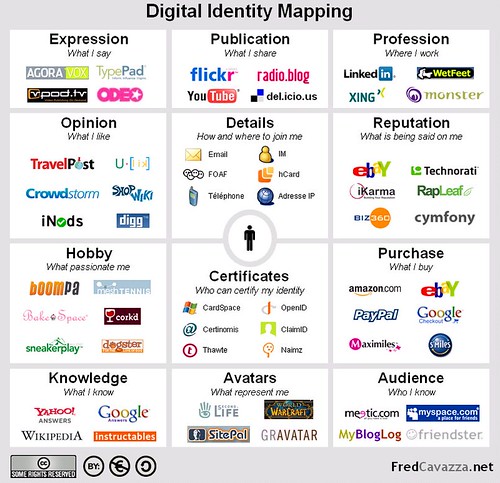
Digital Identity Mapping


Digital Identity Mapping, originally uploaded by fredcavazza.

thanks to mark safranski for this illustration of digital identity

Friday, March 23, 2007

Crowd-sourcing - AssignmentZero


Thanks to KoAnn, CEO of Sustainable Life Media, for this important link about Pro-Am journalism. AssignmentZero is co-sponsored by Wired and is an innovative approach to orchestrating conversations between professonal editors and amateur journalists. I believe this editoral approach can have useful application in online interaction between authors and readers of networked books.

Get Involved | AssignmentZero

" To get the project started, Assignment Zero editors have identified some relevant topics and broken them down into assignments - like an interview, research, or writing a piece. Each of the assignments is marked with either a crowd or individual symbol. The crowd symbol means that this assignment is open to everyone -- it's non-exclusive and ongoing. You can add information at any time".


I will be exploring how AssignmentZero manages their Pro-Am integration.

Tuesday, March 20, 2007

iinnovate - an interview with Eric Schmidt CEO of Google.


A major driving force for innovation in the Silicon Valley springs from the entrepreneurial environment of the Stanford campus - here 2 bright Stanford entrepreneurs-to-be interview Eric Schmidt the CEO of Google - worth a listen. As Schmidt says " I come to Stanford to teach because I always learn a lot from my students questions'" There are some great student's questions in this interview with the CEO of one of the most successful entrepreneurships in Silicon Valley history.

iinnovate: a podcast about innovation and entrepreneurship: Eric Schmidt, CEO of Google

GTD -Because getting organized should be fun.


GTDrawings

From the designer Joan M Mas in the Balearic Islands, Spain - Joan has designed a portfolio of typographic designs and dingbats that could be very useful in visualizing networked book elements. Iwill be contacting her to see how we might work together.

The link to Joan is courtesy of Karen Storer Picture It Solved - a visual approach to thinking

YouTube - Hilary 1984 Spoof Video

You have probably already seen this YouTube video takeoff on the Apple Macintosh 1984 Superbowl ad - My departed friend Fred Hoar, then the PR chief at Apple,felt it was his signature moment in the world of branding - It is clear 23 years later that this commercial "has legs" enought to provide a NewMedia disruption in the 2008 presidential sweepstakes.

Monday, March 19, 2007

Maps of Science

This map was constructed by sorting roughly 800,000 published papers into 776 different scientific paradigms (shown as pale circular nodes) based on how often the papers were cited together by authors of other papers.scimaplarge.jpg (JPEG Image, 6013x5782 pixels) - Scaled (10%)

the map view can be enlarged to make the text labels on the map readable.

Saturday, March 17, 2007

Viral Video Chart - Today's Top 20 Viral Videos

Viral Video Chart - Today's Top 20 Viral Videos

wikinomics presentation by Don Tapscott


This will take you to the eLarning site where you can download and listen/view Don Tapscott's presentation of Wikinomics. I was in Mexico when Tapscott presented on the Cisco campus so I am grateful to John Maloney of Colabria and eLearning for the fully documented archive of Tapscott's talk. eLF vPortal I now will take up Tapcott's challenge in the Wikinomics Playbook to attempt to add value to his work.

This is a powerful example of the emerging concept of the networked book.Thoughts Illustrated: WIKINOMICS-another "Networked" book example

Lunching with Scoble

After a lifetime of accusations of my being a verbal "firehose", I met my match yesterday at lunch at Mike's restaurant with The Scobleizer. It was a truly enjoyable experience. Robert seems to have perfected the ability to integrate his in-person reality with his online presence. He radiates intelligence, good humor and an openness in conversation which is a rare combination - and probably the reason he continues to attract such a large following in the blogosphere and in F2F interactions with the movers and shakers of the geek world.

I first met Robert at Meshforum in May 2006 Thoughts Illustrated: Meshforum - Scoble and Israel on Naked Conversations where he stimulated my curiosity and interest in how he and Shel Israel approached the creation of Naked Conversations - an early version of what I call the Networked Book.

During our lunch yesterday, Robert explained the rationale for his Scoble Show - a relaxed- style interview show featuring hot Silicon Valley CEOs telling their stories and demonstrating their products. Here's a recent example: Inside a real Silicon Valley garage startup: Maya's Mom | PodTech.net: Technology, Business, Media, and News Podcasts. Robert is rapidly accelerating his video interview production, recording 3-4 video interviews per week. He now has a large backlog of wannabe's lined up to be interviewed on his show and expects to select a "Top 40" from his show portfolio when he has enough footage in his playlist archive.

If you are interested in how The Scoble Show integrates with Podtech's business model, scroll down the right side of the page linked above and you will see the logos of 39 high-class Scoble Show sponsors. John Furrier's recruiting of Robert Scoble to be a centerpiece of PodTech's NewMedia business is clearly paying off.

Robert also showed me how he uses google reader to keep up with his prodigious daily blog reading and posting efforts and gave me a short guided tour of how he uses Twitter / Scobleizer to keep up with his many contacts in real time.

Great lunch - and an in-person confirmation of the unique social networking power of the NewMedia to connect and engage people in "naked conversations" on a global basis. Also solid evidence of my friend Mark Anderson's Thoughts Illustrated: Mark Anderson-Welcome to the Blogosphere!support for the AORTA (Always On Real Time Access) concept of today's technology-enabled society. Here's how Mark described it way back in 1998:
"With AORTA, users tend to transfer all work to Net-enabled applications, and to use email, Inet chat, collaboration software, and Inet telephony as easily as they used to use the phone."
Robert Scoble is the living, breathing exemplar of AORTA in action and, boy, does it work for him!

Monday, March 12, 2007

The greatest innovations of all time


View the Slide Show The Greatest Innovations of All Time

Business Week's slide show design tells the story visually. An accompanying audio podcast would make the presentation more compelling.

Sunday, March 11, 2007

Are Crowds Intelligent Life Forms?

You are looking at the Head Lemur who pens raving lunacy which I put on my
my google reader just to sample his oxymoronic humor - which is often pointed in a similar direction to my own exploration of how to refine the "landfill" of the web into useful nuggets suitable for digestion by the folks afflicted with the disease continuous partial attention (CPA).Thoughts Illustrated: Who is Linda Stone and why should we listen to her?

I agree with the raving lunatic's comment:
" One of the most remarkable things about the Internet is the awesome amount of information that is out here. You can find something on just about anything here. But this place is like a huge library where the shelves are empty and the books are piled on the floor. The pile is getting bigger as another truckload has just been delivered in the backdoor. It is all here, but it has little structure or form."


Perhaps the Head Lemur and I can find a way to build a pilot refinery. I intend to risk being subjected to his rapier-like wit, if I can get on his wave length.

raving lunacy: Are Crowds Intelligent Life Forms?

Saturday, March 10, 2007

What were they saying? Tag Clouds from US Presidential Speeches from 1776 to the present


Sliding the timeline bar across the tag cloud space provides an impressive look at the key topics at the "top of mind" in Presidential speeches from John Adams to George W.

This demo also shows the visualizing power of the tag cloud done with just 2 levels of font size and color differentiation. Each cloud contains 100 tags.

From the website of Chirag Mehta a 26 year old kayaking programmer. Original link from the ifBook blog on a networkedbook: GamerTheory

US Presidential Speeches Tag Cloud - Chirag Mehta : chir.ag

Tags

ShareThis

Ti panel